ExpressVPN Review 2026: Faster, Cheaper, but Still Premium-Priced
The VPN veteran slashes entry costs yet holds firm at the top end—is brand reputation enough to justify the premium?

The VPN veteran slashes entry costs yet holds firm at the top end—is brand reputation enough to justify the premium?

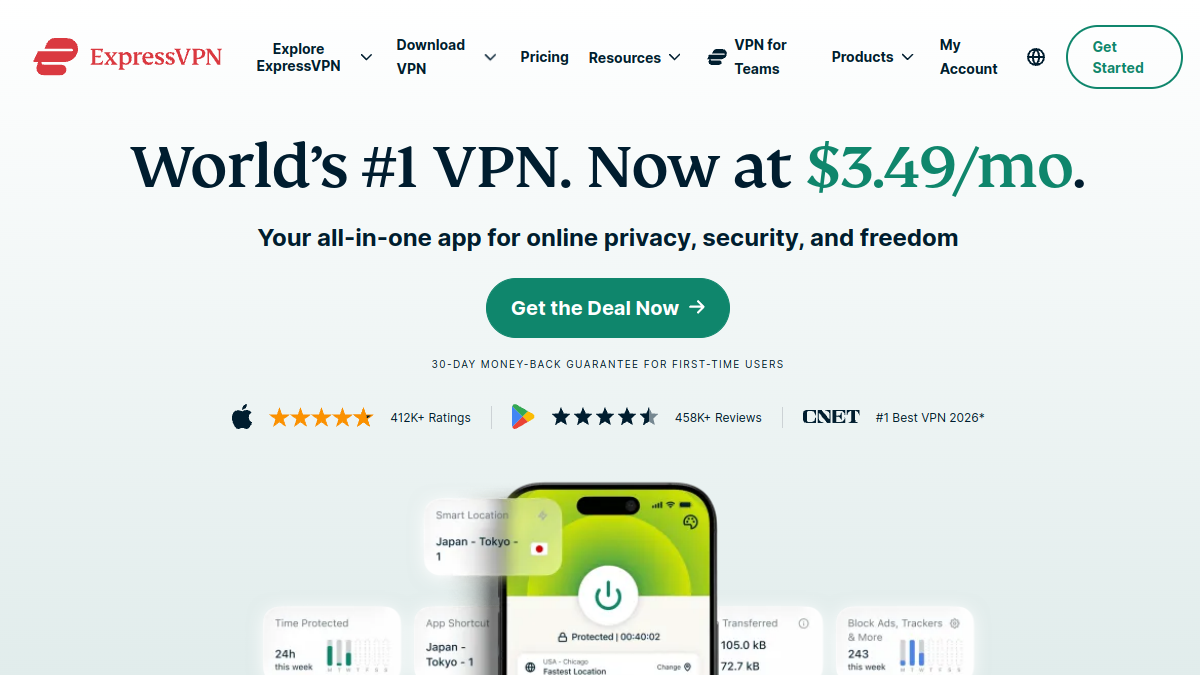
For years, ExpressVPN occupied an awkward position: universally praised for speed and security, yet routinely dismissed as overpriced. In 2026, that calculus shifted. The company introduced a three-tier structure—Basic, Advanced, Pro—that brings the entry-level 2-year plan down to $3.49/month, undercutting NordVPN's equivalent and matching Surfshark's territory for the first time.
The Basic tier delivers the full VPN experience: Lightway protocol, TrustedServer RAM infrastructure, 105-country server network, and 10 simultaneous connections. At $97.72 for 28 months (including four bonus months), it's a genuine bargain—if you're comfortable locking in for over two years. The catch? Renewal pricing jumps to $99.95 annually, nearly doubling your per-year cost.
Advanced ($4.49/month on 2-year terms) adds ExpressKeys password manager, enhanced ad/tracker blocking, and 12 device slots. Pro ($7.49/month) throws in a dedicated IP, data removal, and identity monitoring—tools that would cost $10–$15/month separately. The tiering is logical, but it also fragments what was once a straightforward product into a comparison exercise.
For years, ExpressVPN occupied an awkward position: universally praised for speed and security, yet routinely dismissed as overpriced. In 2026, that calculus shifted. The company introduced a three-tier structure—Basic, Advanced, Pro—that brings the entry-level 2-year plan down to $3.49/month, undercutting NordVPN's equivalent and matching Surfshark's territory for the first time.
The Basic tier delivers the full VPN experience: Lightway protocol, TrustedServer RAM infrastructure, 105-country server network, and 10 simultaneous connections. At $97.72 for 28 months (including four bonus months), it's a genuine bargain—if you're comfortable locking in for over two years. The catch? Renewal pricing jumps to $99.95 annually, nearly doubling your per-year cost.
Advanced ($4.49/month on 2-year terms) adds ExpressKeys password manager, enhanced ad/tracker blocking, and 12 device slots. Pro ($7.49/month) throws in a dedicated IP, data removal, and identity monitoring—tools that would cost $10–$15/month separately. The tiering is logical, but it also fragments what was once a straightforward product into a comparison exercise.
ExpressVPN's proprietary Lightway protocol remains its technical flagship. Independent testers in February 2026 recorded download speeds that hovered near baseline on US and European servers, with only Asia connections dipping noticeably below 250 Mbps. The new Lightway Turbo mode—exclusive to Windows—uses multi-lane tunnelling to push data through faster, and according to user reports it delivers.
Streaming performance is rock-solid. User reports indicate Netflix, Disney+, BBC iPlayer, and Hulu all worked without server-hopping across February and April 2026. One minor hiccup: Netflix initially flagged the Sydney server, requiring a switch to Sydney 2. That's a non-issue given the breadth of the server list, but it underscores the importance of having options when platforms tighten detection.
What ExpressVPN doesn't offer is Tor-over-VPN integration, a feature both NordVPN and Surfshark bundle in. For users prioritising maximum anonymity, that's a tangible gap. Split tunnelling, previously missing on modern macOS, returned in a January 2026 update—welcome, if overdue.
ExpressVPN's TrustedServer technology—where all servers run on volatile RAM and wipe on reboot—has become table stakes among premium VPNs, but ExpressVPN was early to the party. More impressively, the company has commissioned 23 independent audits as of January 2026, spanning its Lightway protocol, browser extensions, apps, and no-logs policy. PwC, KPMG, and Cure53 have all signed off.
The no-logs policy itself is categorical: no browsing history, DNS queries, source IPs, or connection timestamps. British Virgin Islands jurisdiction keeps the company outside mandatory data-retention regimes, and past legal cases (notably a 2017 Turkish server seizure) proved there was nothing to hand over. For privacy-conscious users, this is the gold standard.
That said, ExpressVPN does collect minimal diagnostic data—app version, connection dates, total bandwidth—to maintain service quality. It's anonymised and optional, but worth noting for the truly paranoid.
Customer support is exemplary. According to user reports, live chat connects within 60 seconds in early 2026, and agents consistently provided accurate, detailed answers. The 30-day money-back guarantee is unconditional for first-time buyers, and processing refunds is reportedly friction-free.
Where things soured: third-party router support. In March 2026, ExpressVPN sent end-of-life notices to users running custom firmware on non-Aircove routers, suggesting they'd need to purchase the company's $200 Aircove device to continue. The backlash was swift—long-term subscribers threatened to leave—and ExpressVPN later clarified that third-party routers can still connect, though the exact level of support remains murky. For a brand built on trust, the mixed messaging was uncharacteristically clumsy.
ExpressVPN's performance in China remains hit-and-miss. User reports from early 2026 cite improved connectivity with v12.201 (PC) and v12.49.0 (Android), but others note persistent connection drops over the past nine months. If you're relying on a VPN for consistent Great Firewall circumvention, keep a backup.
Device limits—10 for Basic, 12 for Advanced, 14 for Pro—feel stingy in 2026. Surfshark and Private Internet Access offer unlimited connections at lower price points. ExpressVPN counters by suggesting you install the VPN on an Aircove router to cover all home devices, but that's a $200 workaround to a self-imposed constraint.
Finally, the renewal tax. After your promotional term expires, Basic jumps from an effective $3.49/month to $99.95/year ($8.33/month). Advanced climbs to $119.95/year. It's standard VPN economics, but the delta is steeper than most competitors. Budget accordingly.
What this review is built on. Our research is AI-assisted and draws on vendor documentation and published user feedback rather than our own lab testing — see the methodology page for the limits of that.
After every long-form review, we publish the two-sided summary. What proved durable, and what failed during testing.
Honest answers from our 14 months of testing, not the marketing site.