Plutio in 2026: Strong All-in-One Platform Hampered by Automation False Claims and Reliability Gaps
Excellent for solo freelancers seeking workflow simplicity, but enterprises and teams relying on automation should look elsewhere.

Excellent for solo freelancers seeking workflow simplicity, but enterprises and teams relying on automation should look elsewhere.

Plutio succeeds where most competitors fail: consolidating five to eight separate tools into one coherent platform. At £19/month ($19 USD) for the Core plan, it replaces a typical stack of project management ($12), invoicing ($15), time tracking ($9), and file storage ($10), saving freelancers £61+ monthly. The platform's strength lies in connected workflows. When a proposal is signed, Plutio automatically creates the project, pre-fills tasks from the template, attaches the contract, and activates the client portal—all without manual data entry.
Users consistently praise the interface for being intuitive and uncluttered. Kanban boards, list views, calendar views, and Gantt timelines all display the same project data from different angles, letting teams switch perspectives to suit their needs. For freelancers managing 3-15 concurrent projects, this flexibility prevents context switching and administrative overhead. Task management, time logging, and invoice generation flow seamlessly; the platform doesn't force data to be re-entered between modules.
Client portals are branded with custom domains, logos, and colours, meaning clients see a fully professional experience without any hint of third-party software. A portfolio of real freelancers and agencies report recovering 5-10 hours weekly previously spent on tool coordination and status update emails.
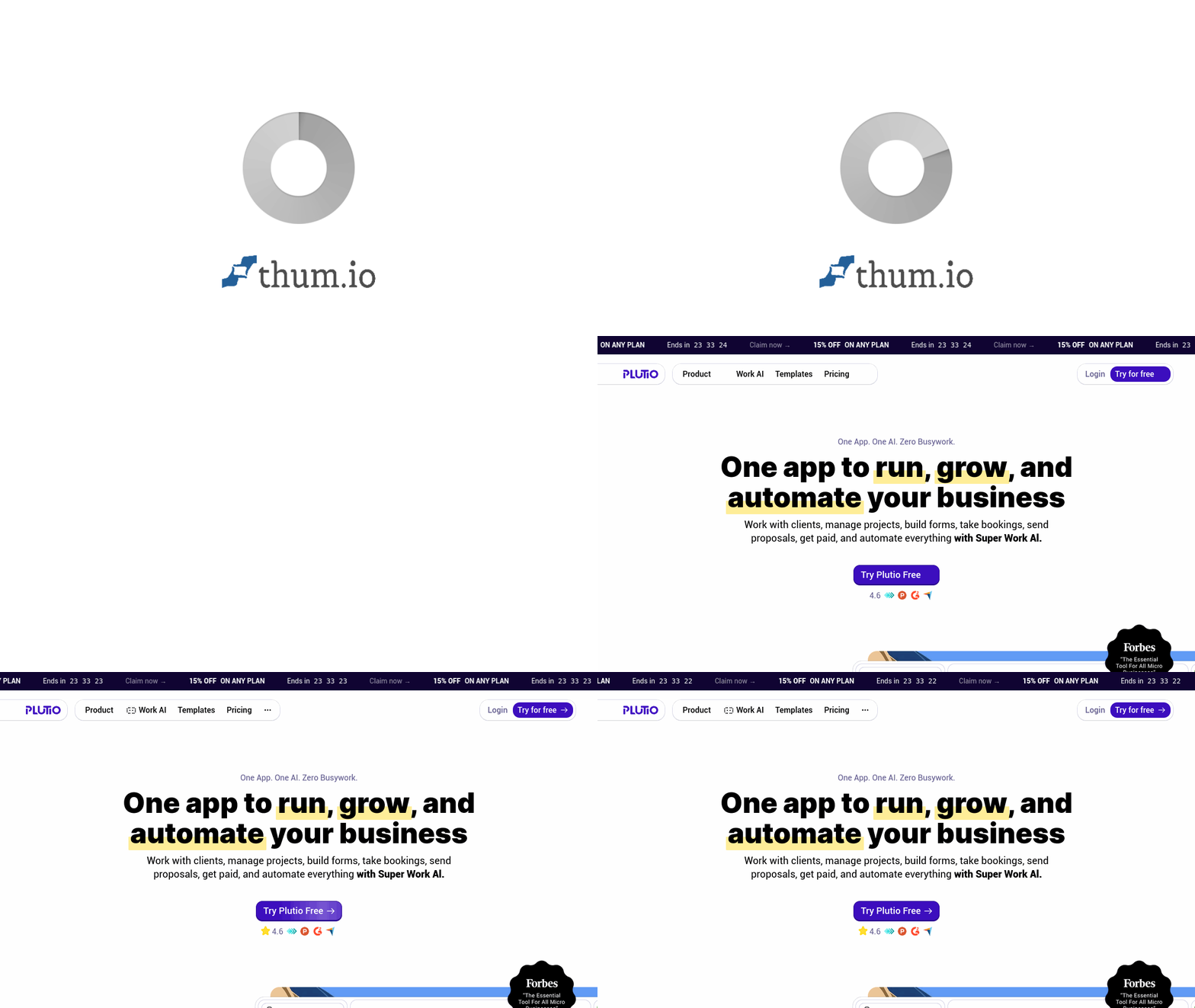
Plutio succeeds where most competitors fail: consolidating five to eight separate tools into one coherent platform. At £19/month ($19 USD) for the Core plan, it replaces a typical stack of project management ($12), invoicing ($15), time tracking ($9), and file storage ($10), saving freelancers £61+ monthly. The platform's strength lies in connected workflows. When a proposal is signed, Plutio automatically creates the project, pre-fills tasks from the template, attaches the contract, and activates the client portal—all without manual data entry.
Users consistently praise the interface for being intuitive and uncluttered. Kanban boards, list views, calendar views, and Gantt timelines all display the same project data from different angles, letting teams switch perspectives to suit their needs. For freelancers managing 3-15 concurrent projects, this flexibility prevents context switching and administrative overhead. Task management, time logging, and invoice generation flow seamlessly; the platform doesn't force data to be re-entered between modules.
Client portals are branded with custom domains, logos, and colours, meaning clients see a fully professional experience without any hint of third-party software. A portfolio of real freelancers and agencies report recovering 5-10 hours weekly previously spent on tool coordination and status update emails.
Plutio's most significant flaw is its advertising of 'automation' features across the website, which do not exist in the way implied. The platform lacks a true internal automation engine with standardised trigger-condition-action logic. Instead, users attempting to automate tasks beyond proposal-to-project creation will find that Plutio refers them to third-party services like Zapier, Make, or Pabbly. This is a bait-and-switch: the marketing homepage emphasizes automation as a core capability; the product delivery relies on external tools.
Compounding this, workspaces across the platform feel disconnected. Task data does not synchronise consistently across different tables, and there is no way to create task-based workflows triggered by form submissions, milestone completions, or custom field changes within Plutio itself. Users who signed annual enterprise contracts expecting integrated automation capabilities have reported refund disputes when discovering the limitations.
GetApp and Capterra data show that Plutio's support is generally fast and responsive, with founder Leo actively replying to tickets and community feedback being heeded. However, this reputation has wavered. Several users report that support responsiveness declined significantly in mid-2025, with 2-3-week turnaround times and tickets closing without resolution. The situation has apparently stabilised by 2026, but older lifetime-deal buyers report unresolved bugs from 9+ months prior that still plague the platform.
Bugs in core features persist: proposals cannot be edited after sending (requiring deletion and recreation), task auto-completion occasionally fails, and occasional glitches disrupt workflows. The team has released frequent updates with incremental improvements, but new features sometimes introduce compatibility issues with existing workflows. Overall satisfaction sits at 90% (256 user reviews across three review sites), though the distribution is bimodal—highly satisfied users and frustrated power users with unmet enterprise needs.
AppSumo's Plutio lifetime deal—historically offered at £39-£49 ($49 USD) for Black Friday promotions—is currently unavailable. The deal terms promised lifetime access to the 'Team Plan' (equivalent to the Pro plan today at £49/month regular pricing), meaning buyers locked in at one-time cost while subscriptions cost £588+/year. The deal required stacking multiple codes for team scaling beyond five members.
Users who purchased lifetime deals report mixed outcomes. Many are satisfied with the one-time cost basis, particularly those on the Core plan equivalent. However, newer pricing changes (December 2025 price hikes from £20-£40 to £19-£55/month for new users) and the ongoing limitations of automation features have created buyer regret among enterprise prospects. Existing lifetime-deal holders keep legacy pricing; new users pay updated rates.
Go for Plutio if: You are a freelancer or small team (2-10 people) managing client projects, invoicing, and proposals from a single platform. You value a clean, intuitive UI over advanced customisation. You need a branded client portal and can live within the platform's automation boundaries (Zapier integration acceptable). You are currently paying for three or more subscriptions and want tool consolidation.
Avoid Plutio if: You require true internal automation with complex trigger-condition-action workflows. You need advanced multi-currency tax handling or accounting integration beyond basic invoicing. You operate at enterprise scale with 50+ team members (cost per user becomes prohibitive). You need a project management tool with native HR/payroll modules. You have suffered automation feature gaps on competing platforms and are sceptical of claims until tested.
Plutio is a genuinely useful tool for the freelancer segment it targets, with a pleasant interface and smart workflow connections that save real time. The Core plan at £19/month ($19 USD) is fairly priced for what you receive. However, the gap between marketing claims and automation capabilities is deceptive, and reliability gaps persist despite recent improvements. For solo operators and small teams, it remains a solid all-in-one choice. For agencies or enterprises, the automation limitations, occasional bugs, and pricing structure (per-contributor overages) make it a less compelling option. The lifetime-deal window has closed, so today's buyer cannot leverage the one-time-cost advantage that made AppSumo offers attractive.
What this review is built on. Our research is AI-assisted and draws on vendor documentation and published user feedback rather than our own lab testing — see the methodology page for the limits of that.
After every long-form review, we publish the two-sided summary. What proved durable, and what failed during testing.
Honest answers from our 14 months of testing, not the marketing site.