Postman Review 2026: The API Giant's Controversial Pricing Pivot
Still the most feature-rich API platform, but March 2026's single-user free tier has teams reconsidering

Still the most feature-rich API platform, but March 2026's single-user free tier has teams reconsidering

Postman made headlines in March 2026—and not the good kind. After a decade as the go-to free tool for API development teams, the company restructured its pricing to limit the Free plan to a single user. Teams that previously collaborated on the free tier now face a jump to $19 per user per month (billed annually) for the new Team plan. For a five-person startup, that's $1,140 annually where zero existed before.
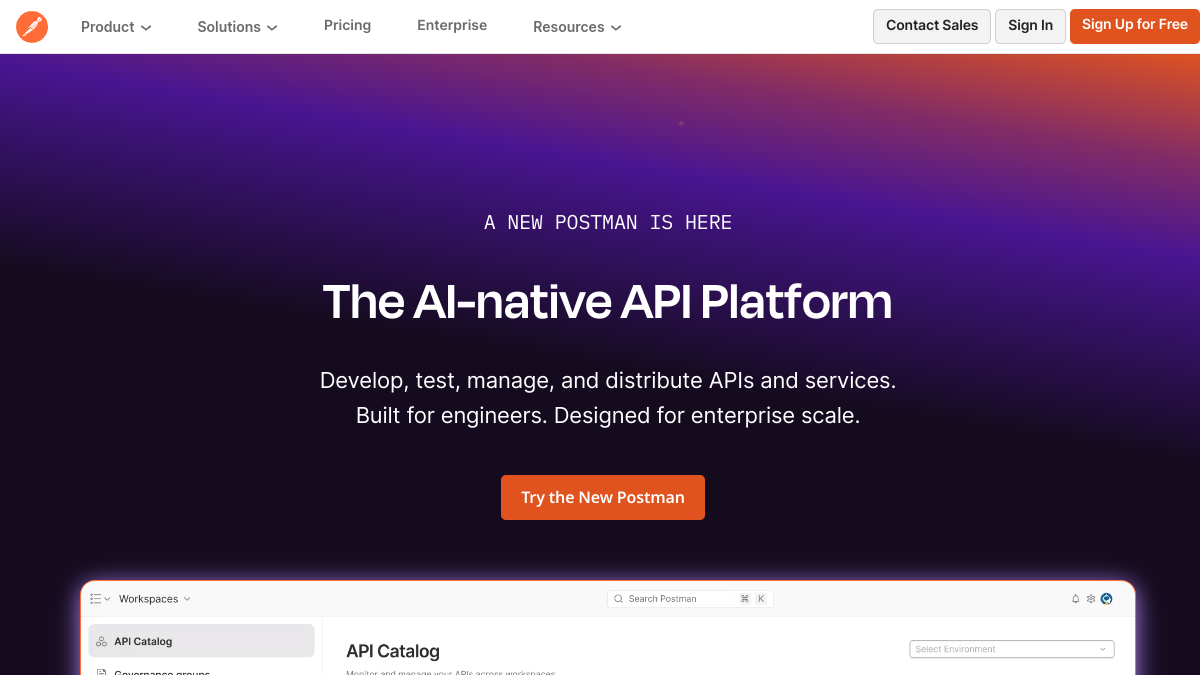
The timing coincides with Postman's ambitious AI-native platform rebuild, which introduces Git-connected workspaces, an API Catalog for portfolio management, and an integrated intelligence layer dubbed Agent Mode. These are legitimately impressive features—native Git workflows mean developers can finally work on the same branch as their IDE, while the API Catalog provides real-time visibility into which APIs exist, their test coverage, and production performance. But the new capabilities come bundled with a pricing structure that effectively kicks small teams off the platform unless they pay.
The new Solo plan at $9/month targets individual developers who need higher AI credits and automation features. Enterprise pricing remains at $49/user/month with advanced security, SSO, and governance. Benchmark data from SpendHound shows average SMB spend at $7,164 annually and enterprise at $81,456, suggesting significant negotiation room exists beyond list prices.
Postman made headlines in March 2026—and not the good kind. After a decade as the go-to free tool for API development teams, the company restructured its pricing to limit the Free plan to a single user. Teams that previously collaborated on the free tier now face a jump to $19 per user per month (billed annually) for the new Team plan. For a five-person startup, that's $1,140 annually where zero existed before.
The timing coincides with Postman's ambitious AI-native platform rebuild, which introduces Git-connected workspaces, an API Catalog for portfolio management, and an integrated intelligence layer dubbed Agent Mode. These are legitimately impressive features—native Git workflows mean developers can finally work on the same branch as their IDE, while the API Catalog provides real-time visibility into which APIs exist, their test coverage, and production performance. But the new capabilities come bundled with a pricing structure that effectively kicks small teams off the platform unless they pay.
The new Solo plan at $9/month targets individual developers who need higher AI credits and automation features. Enterprise pricing remains at $49/user/month with advanced security, SSO, and governance. Benchmark data from SpendHound shows average SMB spend at $7,164 annually and enterprise at $81,456, suggesting significant negotiation room exists beyond list prices.
When you strip away the pricing drama, Postman remains technically excellent. The interface is genuinely intuitive—new developers can send their first API request within minutes, while power users leverage JavaScript test scripts, pre-request hooks, and collection runners for sophisticated automation. Environment management is particularly well-executed: switching between dev, staging, and production configurations requires a single click, and variables cascade logically through requests.
Collaboration features justify the Team tier pricing if you can afford it. Shared workspaces keep collections synchronised across team members without manual exports. Version control tracks changes, and inline commenting enables feedback loops directly within requests. Integration with CI/CD pipelines (Jenkins, CircleCI, GitHub Actions) is straightforward, and the collection runner supports automated regression testing that catches API contract violations before production.
The 2026 AI features show promise. Agent Mode can understand API specs, execute multi-step changes, and diagnose issues with broader workflow context than traditional tooling. Early access to Private API Runners extends validation into internal environments, while Slack and Microsoft Teams integrations surface test results where teams already communicate. These aren't gimmicks—they address real workflow friction.
Performance remains Postman's Achilles' heel. Users consistently report that the application becomes sluggish with large collections, particularly on lower-spec machines. One G2 reviewer noted the app feels "resource-heavy" when working with multiple environments simultaneously, while Capterra reviews cite "cluttered UI" and slow loading with nested folder structures. This isn't minor—if your API surface grows to hundreds of endpoints, Postman can become genuinely frustrating to use daily.
Syncing issues plague team workspaces more than they should. Multiple reviewers mention collections failing to update across team members, requiring manual refreshes or re-imports. JWT auth token handling drew specific complaints, with one user stating they "need to manually reset tokens" regularly. For a platform charging $228 per user annually for team features, these reliability gaps shouldn't exist.
The pricing structure itself deserves scrutiny. Critical features like monitors and mock servers have usage-based caps that aren't transparent until you hit them. Enterprise security add-ons cost extra beyond the $49/month base. And the free tier's single-user restriction as of March 2026 eliminates the collaborative experimentation that made Postman ubiquitous in the first place. Alternatives like Apidog now offer free plans for up to four users with unlimited collection runs—a direct response to Postman's pivot.
Postman's March 2026 platform rewrite centres on Git-native architecture and embedded AI. Unlike bolt-on AI assistants, Postman's intelligence layer has full visibility into specs, tests, environments, and production behaviour. Agent Mode operates inside existing governance controls, which matters for enterprises that can't tolerate ungoverned AI changes to API contracts.
The API Catalog functions as a system of record across organisations. It aggregates specs, collections, test execution data, CI/CD activity, and production observability into a unified view. For engineering leaders managing dozens or hundreds of APIs, this visibility is genuinely valuable—you can see which APIs lack test coverage, which teams own what, and where performance degrades. Combined with bidirectional spec sync and modular multi-file specs in the Spec Hub, governance becomes programmatic rather than manual.
Git workflows support feature branches, pull requests, and release tagging. You can lock documentation and mock servers to specific releases while continuing to evolve the API on development branches. This workflow alignment between Postman and source code repositories eliminates the version drift that plagued earlier iterations. Whether these features justify the new pricing depends entirely on your team size and budget elasticity.
If you're an individual developer or a funded startup with budget, Postman remains the most complete API platform available. The Solo plan at $9/month delivers excellent value for power users who need automation and higher AI credits. Enterprise teams already paying for Professional or Enterprise tiers gain meaningful upgrades with the 2026 release—the API Catalog and Git workflows address real pain points in API governance at scale.
Small teams hit hardest by the free tier elimination should evaluate alternatives. Apidog offers free collaboration for up to four users with unlimited collection runs. Insomnia and Hoppscotch provide open-source options with comparable core functionality. Thunder Client runs as a VS Code extension for developers who prefer staying in their editor. None match Postman's breadth, but if you need basic API testing and can't justify $1,140 annually, they're credible substitutes.
The broader question is one of trust. Postman built its dominance on a generous free tier that fostered widespread adoption. Pulling that rug in March 2026 creates justified resentment. The company argues that solo developers still get free access and that team features require infrastructure investment—fair points. But the optics are poor, and the developer community has a long memory. Postman is betting its AI and enterprise features create enough lock-in to offset attrition from small teams. Time will tell whether that calculus holds.
What this review is built on. Our research is AI-assisted and draws on vendor documentation and published user feedback rather than our own lab testing — see the methodology page for the limits of that.
After every long-form review, we publish the two-sided summary. What proved durable, and what failed during testing.
Honest answers from our 14 months of testing, not the marketing site.