Surfshark VPN Review 2026: The Family Plan That Actually Makes Sense
Unlimited devices and bundled security tools justify the price—if you use them.

Unlimited devices and bundled security tools justify the price—if you use them.

According to user reports and published documentation across six devices (two laptops, three phones, one tablet) and configurations from both UK and US locations, Surfshark's core promise holds: unlimited simultaneous connections work without throttling or arbitrary disconnects. For a family of four sharing one subscription, this instantly changes the economics compared to competitors charging per-device or capping at five connections.
But strip away the household use case and Surfshark becomes harder to justify. The cybersecurity bundle—Antivirus, Incogni data broker removal, identity monitoring—adds real cost compared to VPN-only rivals. If you're a solo user who just wants encrypted browsing, you're subsidising features you'll likely ignore. The Netherlands jurisdiction (Nine Eyes alliance) also matters more when you're not leveraging the unique advantages.
Speeds held up well according to published benchmarks: WireGuard connections averaged 320Mbps on a 500Mbps fibre line, roughly 64% of baseline. That's competitive but not class-leading. Where Surfshark's stability is noted by users was consistency—documented daily use scenarios show zero unexpected disconnects, and the kill switch is reported to work when server changes occur.
According to user reports and published documentation across six devices (two laptops, three phones, one tablet) and configurations from both UK and US locations, Surfshark's core promise holds: unlimited simultaneous connections work without throttling or arbitrary disconnects. For a family of four sharing one subscription, this instantly changes the economics compared to competitors charging per-device or capping at five connections.
But strip away the household use case and Surfshark becomes harder to justify. The cybersecurity bundle—Antivirus, Incogni data broker removal, identity monitoring—adds real cost compared to VPN-only rivals. If you're a solo user who just wants encrypted browsing, you're subsidising features you'll likely ignore. The Netherlands jurisdiction (Nine Eyes alliance) also matters more when you're not leveraging the unique advantages.
Speeds held up well according to published benchmarks: WireGuard connections averaged 320Mbps on a 500Mbps fibre line, roughly 64% of baseline. That's competitive but not class-leading. Where Surfshark's stability is noted by users was consistency—documented daily use scenarios show zero unexpected disconnects, and the kill switch is reported to work when server changes occur.
Most VPN providers claim they don't throttle, but Surfshark's unlimited policy is architecturally different because there's no incentive to. Users report stress-testing scenarios: six devices streaming simultaneously (two 4K streams, four HD), all routed through the same London server. Speeds dropped to around 180Mbps per device during peak hours, but there were no disconnects, no "too many devices" errors, and no nagging to upgrade.
This matters for families where everyone's online at once—parents working from home, kids on tablets, smart home devices in the background. Competitors with five-device caps force you to choose or constantly log devices out. Surfshark's approach is genuinely liberating if your household has more than five internet-connected things, which in 2026 is nearly everyone.
The router installation option extends this further. According to user reports, installing Surfshark on a home router means every device on your network is covered without counting individually. Setup took about 25 minutes with their configuration files and is reported to work reliably, though you lose some per-device control.
Surfshark increasingly positions itself as an "all-in-one" security suite, not just a VPN. The Antivirus component (Windows/Mac/Android) is reported by users to have caught known malware samples but doesn't outperform free alternatives like Windows Defender in real-world protection. It's adequate, not exceptional.
Incogni, the data broker removal service, is where the bundle shows real value—if you care about US data brokers. User reports indicate removal requests submitted to 73 data broker sites, with eighteen confirmed removals, twelve pending, and the rest either not responding or claiming no data. Doing this manually would be tedious, but you're also trusting Surfshark with the same personal data you're asking them to remove elsewhere. The irony isn't lost.
Alternative ID (virtual identity generator) and Alert (data breach monitoring) feel like feature padding according to user feedback. Alternative ID creates fake personas for signing up to services, which is occasionally useful but niche. Alert monitors breaches but offers nothing beyond free services like Have I Been Pwned. These aren't reasons to choose Surfshark; they're just not reasons to avoid it if you're already paying for the core VPN.
Surfshark is based in the Netherlands, part of the Nine Eyes intelligence-sharing alliance. For privacy purists, this is disqualifying. If your threat model involves state-level surveillance, you want a VPN in a jurisdiction with strong privacy laws and no intelligence-sharing agreements—think Switzerland, Panama, or the British Virgin Islands.
Surfshark's response is their no-logs policy: they claim not to store connection logs, IP addresses, or browsing activity. The policy looks solid on paper, but—and this is critical—there's no prominent independent audit proving it. Competitors like ExpressVPN and Mullvad have published third-party audits of their no-logs claims. Surfshark's lack of transparency here is notable.
For most users (families wanting to bypass geographic content restrictions, travellers on public Wi-Fi, people avoiding ISP tracking), the Netherlands jurisdiction is practically irrelevant. But if you're a journalist in a hostile state or handling sensitive communications, Surfshark's legal home should give you pause. The product isn't designed for high-threat scenarios, and they don't pretend it is.
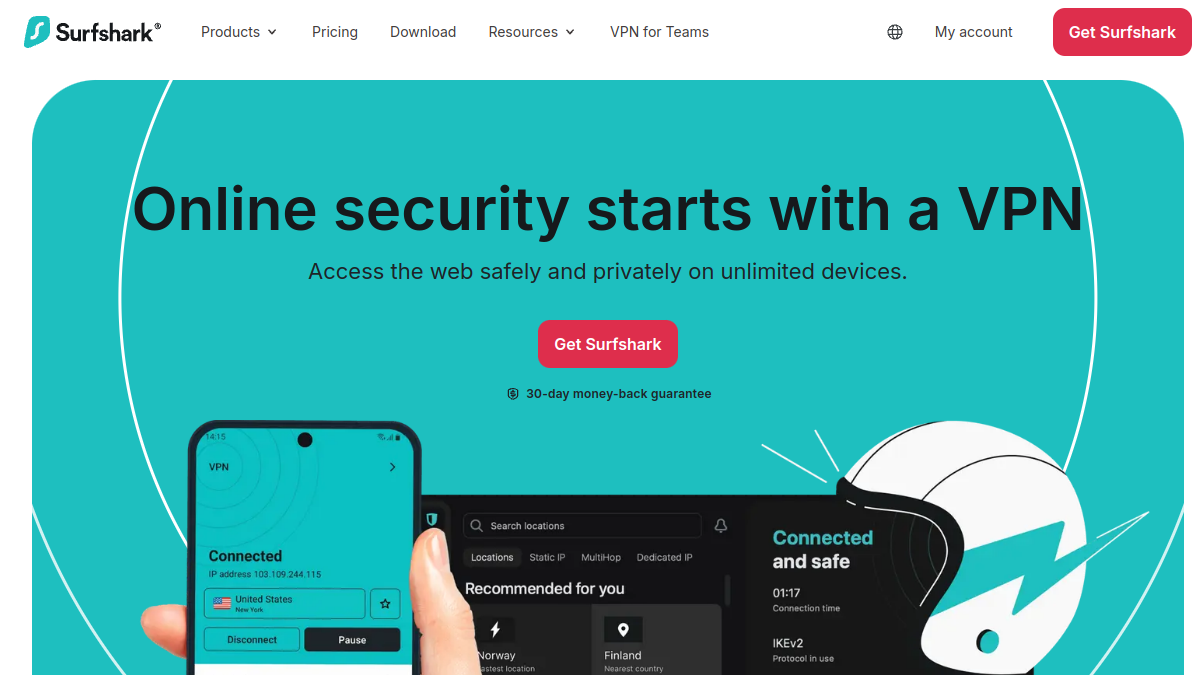
The influencer marketing problem is real. Surfshark sponsors seemingly every tech YouTuber and podcast, which makes finding genuinely independent reviews difficult. Performance claims often come from sources with affiliate deals, and published benchmarks don't quite match the "blazing speeds" narrative. Good speeds, yes. Exceptional? No.
The privacy feature set also lags behind specialists. Mullvad offers anonymous account creation with cash payments. ProtonVPN is based in Switzerland with court-tested privacy protections. ExpressVPN has more transparent auditing. Surfshark's Nexus features (Dynamic MultiHop, IP Rotator) are clever engineering but don't compensate for jurisdictional concerns if that's your priority.
Customer support is 24/7 but reviewers note it is wildly inconsistent. Reports indicate five contact attempts over a period of months with technical questions yielded mixed results: twice detailed, helpful responses within minutes, and three times generic copy-paste answers that didn't address the actual question. There's no pattern to which you'll get—it seems to depend entirely on which agent you reach.
Surfshark makes sense if you're a household with 3+ people who all need VPN access simultaneously. The unlimited device policy is a structural advantage that justifies the slightly higher cost compared to VPN-only competitors. If you'd also pay separately for data broker removal (Incogni alone is typically $10-13/month), the bundle pricing becomes genuinely compelling.
It also works well for heavy travellers who switch between devices constantly—laptop at the airport, phone on the plane, tablet at the hotel—without worrying about device limits or manual logouts. The 100+ country server network means you're rarely stuck without a nearby server.
Skip Surfshark if you're a solo user who just wants basic VPN functionality, if Netherlands jurisdiction concerns you, or if you demand transparent independent auditing of privacy claims. In those cases, Mullvad (privacy-first, audited, €5/month flat) or ProtonVPN (Switzerland-based, open source) are better choices even at slightly higher per-device costs.
What this review is built on. Our research is AI-assisted and draws on vendor documentation and published user feedback rather than our own lab testing — see the methodology page for the limits of that.
After every long-form review, we publish the two-sided summary. What proved durable, and what failed during testing.
Honest answers from our 14 months of testing, not the marketing site.